

Help me grow! Follow In The Hyphen on YouTube, Instagram and TikTok. If you’d like to support my work, check out my Patreon.
Hi {{first_name | friend}},
This newsletter is long, but I think it’s well worth your time. A lot happened this week, more than any week since I started this newsletter in February. Let’s get into it.
In this newsletter, I’m exploring the hyphen between:
🔠 Last names - United States
🎺 Mariachi - politics
💰 Latinos - wealth
- Fernando
New Census data shows most common first and last names in the U.S.

The U.S. Census Bureau this week released data showing the most common first and last names reported in the 2020 census.
The biggest change this year? Six of the top 15 last names are “predominantly Hispanic last names.” Here are the top 15, with the most common at the top. See if you can spot the six Hispanic ones.
Smith
Johnson
Williams
Brown
Jones
Garcia
Miller
Rodriguez
Davis
Martinez
Hernandez
Lopez
Gonzalez
Wilson
Anderson
The chart below shows how the names have changed over time. Purple signifies names that have been in the top 15 in all the years listed. Red names signify a new entrant that year. You can see that eight of the top 15 last names have stayed in the top since 1790.

(Photo: U.S. Census Bureau)
Here’s what else is interesting. The U.S. Census Bureau also identified the 15 fastest-growing last names from 2010 to 2020. Fourteen of them are predominantly Asian and Native Hawaiian and Other Pacific Islander.
A message from our sponsor
Daily news for curious minds.
Be the smartest person in the room. 1440 navigates 100+ sources to deliver a comprehensive, unbiased news roundup — politics, business, culture, and more — in a quick, 5-minute read. Completely free, completely factual.
Mariachi Reyna de Los Ángeles responds to MAGA allegations

(Photo: Mariachi Reyna de Los Ángeles/In The Hyphen composite)
Last Sunday, Mariachi Reyna de Los Ángeles, an all-female mariachi, joined Karol G and Becky G onstage at Coachella.
I, among others, made a video about the moment.
Within hours, videos started getting flooded with comments alleging the group’s owner, José Hernández, and his daughter (who is part of the group), Crystal Hernández, were MAGA sympathizers. Many saw it at odds with the group’s business, which some say is built off Mexican culture and many Mexican consumers, including immigrant consumers.
The allegations stem from a few things, including:
José Hernández’s wife, Teresa, who is listed as Hernandez Productions’ chief financial officer in California business filings as of 2025, has been vocal about her support for Trump in the past. Hernandez Productions is the parent company of Mariachi Reyna de Los Ángeles.
From 2021 to 2025, Teresa was the president of the Lincoln Club of Orange County, which describes itself as “California’s oldest and largest Conservative donor organization”
José and Crystal follow conservative accounts on Instagram
José has posted statements supportive of President Donald Trump on his public Facebook profile
I reached out to Mariachi Reyna de Los Ángeles for comment yesterday morning with a deadline of 6 p.m. PDT today, but late last night, I saw the group finally responded. Not to me, but to another news outlet. NBC Los Angeles interviewed Crystal Hernández and asked her about the allegations directly.
During the interview, reporter Amber Frias asks, “In the past few days, there’s been some bittersweet feelings from people who are so proud to see you guys out there, but they also bring up the topic of … political affiliations that may not reflect that of some of your fans.”
The group’s public relations representative interrupts right away and can be heard off-camera saying, “Amber, I’m going to hold it. Excuse me. We provided a statement already.”
That statement, according to Frias, reads in part, “The founder and director of Mariachi Reyna has not made public statements endorsing any political candidate.”
While José Hernández hasn’t released official statements on any political candidate, his public Facebook profile does show support for at least some of Trump’s policies, like this post from October 2025.
In the NBC Los Angeles interview, Crystal Hernández does eventually respond. She says, “Being up there on that stage, people know where our hearts are at.”
But she stops short of explaining where the heart is.
In the aftermath of the allegations, there appear to be two camps of people. Some people are saying it’s important consumers know where a mariachi group that profits off Latinos and immigrants aligns politically. Others are commenting saying things like, “So what? Everyone is free to do what they want.”
Which camp are you a part of?
Does who a mariachi group supports politically matter?
Welcome to Mariachi University, USA
In 2021, I remember being surprised when I learned students at the University of Southern California founded a mariachi: Mariachi Los Troyanos de USC. We had no such thing, and no vestige of it, I think, when I was a student there from 2012 to 2015. Well, fast-forward to a few months ago, when I caught wind that UC Irvine also had a mariachi it recently started.
Why were all these universities starting mariachis? I looked into it, and I realized this was nothing new. In fact, many American universities have had mariachi ensembles or courses for years, with the oldest dating back to 1961. I decided to look into this collegiate mariachi trend for my latest mini-doc.
I post a mini-doc every two weeks on my YouTube channel. Subscribe to the channel so you don’t miss the next one.
New report pinpoints five systems that have led to wealth disparity for Latinos

(Photo: Canva/In The Hyphen)
I was today years old when I learned that for every $1 of wealth white households in the U.S. have, Latino households have 22 cents, according to 2022 Federal Reserve data.
A new report looked at why that is, and it found that policy systems, not individual circumstance, are to blame for much of it.
The report from UnidosUS and the UCLA Latino Policy and Politics Institute looked at policy dating as far back as 1848 and outlined five policy systems that contributed significantly to the gap in wealth.
But first… what exactly is wealth? For starters, it is not income.
“Income, on one side, is what you earn,” Gabriella Carmona, senior research analyst at the UCLA LPPI, said. “For most people, that's your paycheck, whereas wealth is actually your net worth. So that's actually what you own minus what you owe. So you can owe or own things like a home, savings — those are assets. And then you owe things like student loans, credit card bills. That's your debt. And wealth is really kind of the balance between the two.”
She sums up the functions of income and wealth like this: “Income is what helps you get by in a lot of ways, but wealth is what helps you get ahead.”
Here are the five policy systems the report says have contributed to low wealth for Latinos:
Immigration policy and foreign relations
Land loss and barriers to home ownership
Unfair pay and job discrimination
Exclusion from the social safety net
Education segregation and access barriers
There’s probably nothing surprising on that list, but what might surprising, is the specific policies or events that, in some cases, explicitly sidelined Latinos. The report breaks those down.
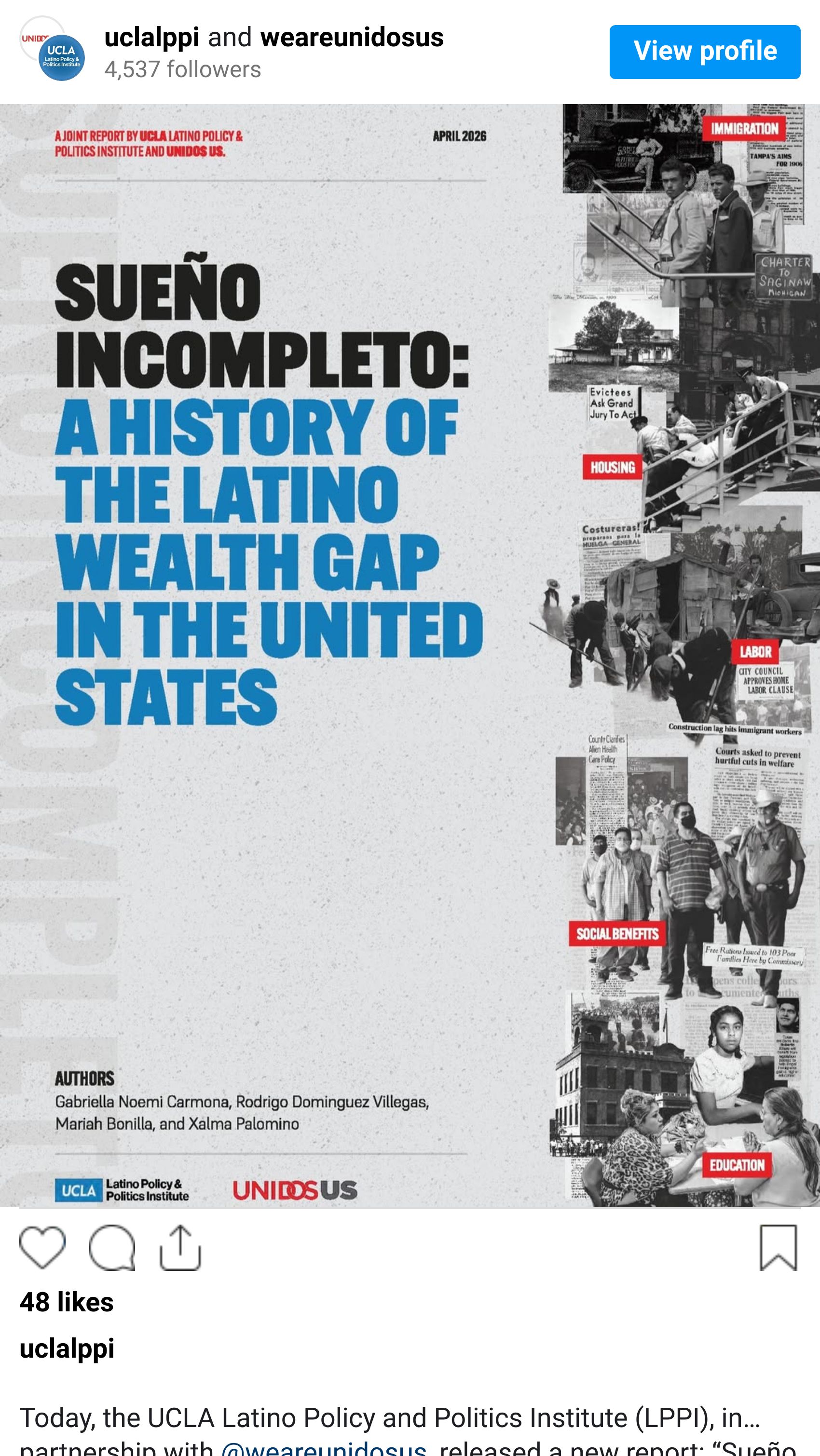
“What our analysis makes clear is how repetitive the history is,” Carmona, who is the lead author of the report, said. “All of the systems generally don't operate separately. They really reinforce each other.”
One example is the GI Bill of 1944, which gave World War II veterans funds for college, unemployment insurance and housing.
“A lot of them were actually Mexican American veterans who came in after fighting the war for their country, and they were promised huge opportunity,” Carmona said. “But in practice, Latino veterans were actually not able to access much of the academic stipends. They were often steered away actually from four year colleges by counselors — or accessing the benefits was just so riddled with barriers.”
I asked Viviana Lopez-Green, who is senior director of the Latino Knowledge Lab at UnidosUS, about the impetus for the report.
“This is creating this clear accessible research to grant contemporary conversations for policy innovation and for community action,” Lopez-Green said. “We don't think that we can fix something unless it's understood. This is not just important for Latinos. This is important for the fiscal health of our whole country because we are nearly 20 percent of the country … and 80 percent of Latinos are U.S. citizens.”
📖 SITYSK: Stuff I Think You Should Know
HIV, AIDS infections are rising among Latinos in Chicago.The number of Latinos with HIV or AIDS in Chicago increased nearly 17% between 2020 and 2024, even as other groups see drops. Of the 818 new HIV cases in Chicago in 2024, nearly half were among Latinos, according to city data and the AIDS Foundation of Chicago. [Chicago Sun-Times]
Are Latinos buying beer again? Constellation Brands, which just months ago sounded the alarm about declining sales among Hispanic consumers, is now seeing some positive news. Shares for the U.S. importer of Corona Extra and Modelo Especial jumped more than 8% after the company said it saw improved sales in Hispanic zip codes. [Barron’s]
A university is offering a Bad Bunny fashion course. Students at the University of New Mexico will be able to take a course this fall called “Bad Bunny: Fashion Revolutions.” The course, taught by Prof. Francisco J. Galarte, will look at “how a single outfit—whether it’s a 1940s-inspired zoot suit or a gender-fluid gown—can challenge the traditional policing of Latinx identity and the history of the Global South.” The course will culminate with a digital exposition where students use AI to generate “speculative” runway looks for the artist. [University of New Mexico]
Is Telemundo cool now? While broadcast networks scramble to capture shares of a dwindling audience, the Spanish-language network has had a strong year, especially with its news programming, across linear and digital platforms. The L.A. Times says the network has been buoyed by the “Bad Bunny” effect. [Los Angeles Times]
Do Jorge Ramos’ Emmy nominations signal a shift in news consumption? The former Univision anchor left his post at probably the biggest job in Spanish-language journalism in the United States in 2024. Months later, he launched Así Veo Las Cosas, his independent journalism venture. How’s that going? Well, in March of this year, alone, he garnered 101 million views across his platforms, and he currently has more than 400,000 subscribers on YouTube. This month, the News and Documentary Emmy Awards nominations were announced and Ramos and his production company, Tres Alebrijes, snatched two of them: Outstanding News Program in Spanish Language and Outstanding Journalist in Spanish Language. He’s up against his former employer and Telemundo in both categories. Sign of the times. We’ll find out who wins on May 27. [Variety]
Eva Longoria revealed she moonlit as a headhunter while starting off as an actress. “I’m gonna get a job. I’m not gonna be a struggling actor.” That’s what Longoria told Fortune in an interview. The actress, producer and entrepreneur said she worked fulltime as a headhunter, making calls from her trailer, while acting in “The Young and the Restless.” [Fortune]
Jarritos enters the prebiotic soda game. Last month, Jarritos quietly launched Sana Sana, a prebiotic soda “rooted in Mexican care and culture.” I say quietly only because I didn’t hear about it. Maybe it was loud. Btw, the name is a reference to “Sana sana colita de rana.” [Mexico Business News]
Really quick
You’re reading this email because you signed up for the In The Hyphen newsletter or because someone forwarded it to you. If it’s the latter, sign up here:
👀 Unrelated, but…
This section is a random musing from the week that is not related to my work as a journalist.
This week’s rant: I saw a guy in L.A. get off a Waymo (the driverless cars) and wave goodbye to it the other day.
And it reminded me: I said hi to one of those Coco meal-delivery robots a few months ago. And then I got sad when I saw another one toppled over on the sidewalk.
And it made me think: Humans are innately thankful. As we replace human jobs with robots, where does our “thanks” go? Does it fall on deaf ears?
Stay hyphy,
Fernando
